Quick Answer
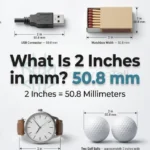
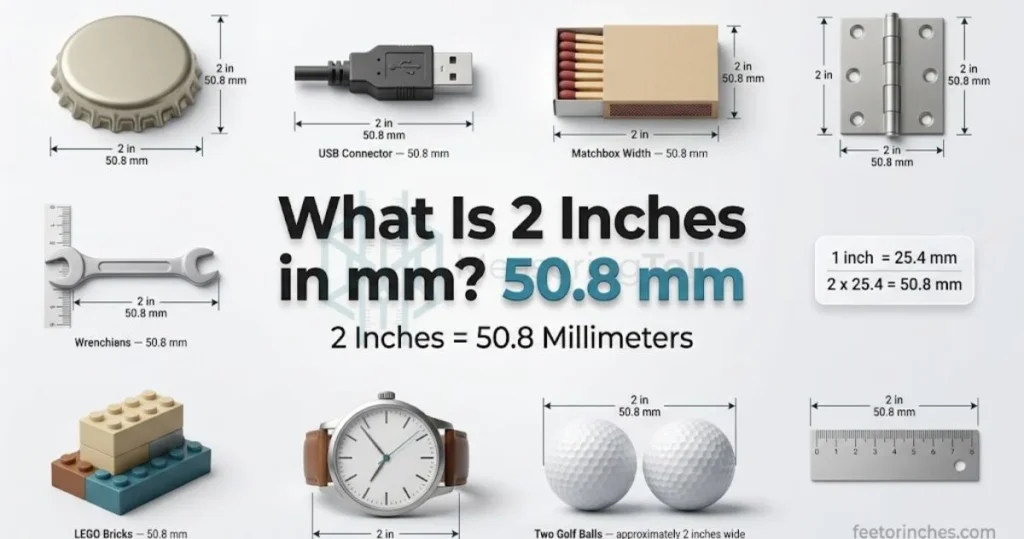
2 inches equals 50.8 millimeters (mm).
To convert inches to millimeters, multiply the inch value by 25.4.
Formula:
Inches × 25.4 = Millimeters
2 × 25.4 = 50.8 mm
When you search for what is 2 inches in mm, you’re usually trying to picture a small but precise length in real life. Two inches is short, but it shows up everywhere—from screws and phone components to small craft materials and DIY measurements.
To help you visualize it better, think of a standard paperclip laid out twice, or the width of a large bottle cap. These everyday comparisons make millimeters easier to understand, especially when precision matters in engineering, design, or shopping online. In this guide, you’ll see clear conversions, real-life examples, and visual references that make 2 inches instantly understandable in millimeters.
Conversion Table: Inches to Millimeters
| Inches | Millimeters (mm) |
|---|---|
| 1 inch | 25.4 mm |
| 2 inches | 50.8 mm |
| 3 inches | 76.2 mm |
| 4 inches | 101.6 mm |
| 5 inches | 127 mm |
| 10 inches | 254 mm |
Quick Insight:
Every 1 inch always equals exactly 25.4 mm, making conversions consistent and reliable.
What Does 2 Inches in mm Mean?
The measurement 2 inches in millimeters (50.8 mm) represents a small linear distance commonly used in both imperial and metric systems.
- The inch is primarily used in the United States and UK engineering contexts.
- The millimeter is part of the metric system, widely used worldwide.
When you convert 2 inches to mm, you’re simply scaling a small imperial measurement into a more precise metric unit. This is especially important in manufacturing, electronics, and construction where even tiny differences matter.
Why This Conversion Matters
Understanding 2 inches in mm is useful because:
- Many global products use metric labeling
- Engineering drawings rely on millimeters
- Online shopping often mixes units
- DIY projects require precision
- Electronics and hardware parts are measured in mm
For example, a 2-inch screw or pipe must match exact millimeter specifications to fit properly.
How the Conversion Works
The conversion is based on a fixed international standard:
1 inch = 25.4 millimeters
So:
- 2 × 25.4 = 50.8 mm
This standard was internationally agreed to ensure consistency across industries like engineering, aviation, and construction.
Real-Life Examples of 2 Inches (50.8 mm)
Here are practical, everyday examples to help you visualize 2 inches in mm (50.8 mm):
Example 1: Large Bottle Cap
- Measurement: ~2 inches diameter
- Visualization: Slightly wider than a golf ball
- Insight: Common in soda or juice bottles
Example 2: USB Plug Length
- Measurement: ~2 inches
- Visualization: Length of a thumb and half
- Insight: Many USB connectors fall in this range
Example 3: Matchbox Width
- Measurement: ~2 inches
- Visualization: Small rectangular box
- Insight: Easy handheld reference
Example 4: Credit Card Short Edge + Extra
- Measurement: 2 inches (50.8 mm)
- Visualization: Slightly longer than a credit card’s width segment
- Insight: Useful for estimating small packaging sizes
Example 5: Door Hinge Plate Width
- Measurement: ~2 inches
- Visualization: Metal rectangle on door frame
- Insight: Standard hardware sizing
Example 6: Smartphone Camera Bump (Large Models)
- Measurement: ~2 inches across cluster
- Visualization: Slightly larger than a coin stack
- Insight: Modern phone designs vary around this range
Example 7: Small Wrench Size
- Measurement: 2-inch tool span
- Visualization: Compact hand tool
- Insight: Used in plumbing and mechanical repairs
Example 8: LEGO Brick Stack (Multiple Layers)
- Measurement: 2 inches height
- Visualization: Several stacked LEGO blocks
- Insight: Helps kids and hobbyists understand scale
Example 9: Wristwatch Case Diameter (Large Watches)
- Measurement: ~2 inches
- Visualization: Large sports watch face
- Insight: Popular in bold fashion watches
Example 10: Golf Ball Cluster (Two Balls)
- Measurement: ~2 inches total width
- Visualization: Two golf balls side-by-side
- Insight: Great sports-related reference
Comparison Section
Smaller than 2 Inches
- Paperclip (~1.5 inches)
- Coin stack (~1 inch)
- Button diameter (~0.8 inches)
Equal to 2 Inches
- Bottle cap width
- Small tool heads
- Compact electronic parts
Larger than 2 Inches
- Smartphone width (~2.7–3 inches)
- Credit card length (3.37 inches)
- Tennis ball diameter (~2.7 inches)
Human Body Comparison
- Thumb width: ~1 inch
- Two thumbs together: ~2 inches
- Palm width: larger than 2 inches
How 2 Inches Feels in Real Life
In human terms, 2 inches (50.8 mm) feels:
- Small enough to hold between two fingers
- Shorter than most everyday tools
- About the width of a large thumb and index finger together
- Easy to overlook unless precision is needed
When walking or estimating distance, 2 inches is almost negligible—but in design or engineering, it becomes very important.
Practical Uses of 2 Inches Measurement
You’ll commonly see 2 inches in mm (50.8 mm) in:
Construction
- Screw sizes
- Pipe fittings
- Bracket measurements
Interior Design
- Cabinet hardware spacing
- Furniture adjustments
- Hinges and fittings
Electronics
- Component sizing
- PCB spacing
- Cable connectors
DIY Projects
- Craft cutting guides
- Wood trimming
- Model building
Shopping
- Online product dimensions
- Packaging sizes
- Accessories
Education
- Measurement learning tools
- Conversion exercises
- Math worksheets
FAQ: 2 Inches in mm
What is 2 inches in millimeters exactly?
2 inches is exactly 50.8 millimeters. This is based on the standard conversion where 1 inch equals 25.4 mm. It is a fixed international measurement used in engineering, construction, and daily conversions.
Why is 1 inch equal to 25.4 mm?
The inch was standardized internationally in 1959. It was agreed that 1 inch equals exactly 25.4 millimeters to unify imperial and metric systems for scientific and industrial accuracy worldwide.
Is 2 inches a large or small measurement?
2 inches is considered a small measurement. It is typically used for small objects like tools, hardware parts, and electronic components. In human-scale terms, it is roughly the width of two thumbs.
How do you quickly convert inches to mm?
Multiply the number of inches by 25.4. For example, 2 × 25.4 = 50.8 mm. This is the fastest and most reliable conversion method.
What objects are 2 inches long?
Common objects include bottle caps, small wrenches, USB connectors, and door hinge plates. These items help visualize 2 inches in real-world settings.
Is 2 inches equal to 5 cm?
Yes, approximately. 2 inches equals 5.08 cm, which is very close to 5 centimeters in practical use.
Why do engineers use millimeters instead of inches?
Millimeters provide higher precision and are part of the metric system, which is easier for scientific calculations and global standardization.
Can 2 inches make a difference in construction?
Yes, even 2 inches can significantly affect alignment, fitting, and structural accuracy in construction and manufacturing projects.
How many mm is 1 inch?
1 inch equals 25.4 mm exactly. This is the base unit for all inch-to-millimeter conversions.
Is 2 inches bigger than a golf ball?
A golf ball is about 1.68 inches in diameter, so 2 inches is slightly larger than a golf ball.
Conclusion
Understanding what is 2 inches in mm (50.8 mm) helps bridge the gap between imperial and metric systems. This small measurement appears everywhere—from tools and electronics to everyday household objects. Once you visualize it with real-world examples, converting and estimating becomes much easier and faster.
Whether you’re working on DIY projects, shopping online, or reading technical specs, knowing this conversion ensures accuracy and confidence in every measurement decision.